Snoring & Sleep Apnea Mouthpiece User Guide
+ Mouth Guard Comparison
Are you trying to stop snoring? One of the most effective and cheapest ways is a Stop Snoring Mouthpiece. But with so many mouthpieces available on the market how can you possibly choose which one to buy? This is where we come in…
This guide will present you with the most commonly used, and effective remedies for excessive snoring and mild to moderate cases of obstructive sleep apnea.
You will find the causes and consequences of snoring and sleep apnea, and a description of the anti-snoring devices most commonly used (including snoring mouthpiece comparison table), which are alternatives to the expensive CPAP machines.
Who is this guide for?
- Those looking for information on mouth guards / mouthpieces and Nasal EPAP
- Those who want an overview of the snoring and sleep apnea device world
WARNING: If you think you have obstructive sleep apnea (OSA), you should go talk to your doctor. OSA can cause high blood pressure, heart failure, and atrial fibrillation (abnormal amounts of heart beats), amongst other things. The more severe levels are dangerous even in the short term.
What Causes Snoring?

It is important to know the causes of snoring to use the right tool to tackle your snoring problem.
Snoring is caused by the partial blockage of airways, which can happen anywhere from the nose to the throat, or near the back of the tongue. The blockage can happen while awake, and worsen during sleep.
When you are sleeping your muscles are more relaxed, making it easier for the airflow to make the softened tissues vibrate; tissues gradually become softer as deeper sleeping stages are achieved.
Many different factors can cause snoring and sleep apnea, such as:
- Aging: with age we lose muscle tone everywhere, including in our throat, making it easier for vibrate to occur and make snoring sounds
- Being over-weight: lack of exercise, over eating or bad eating habits causing weight gain can partially block your throat by making it bulkier
- Alcohol and sleeping pills: both of these will relax your muscles, making them more likely to vibrate
- Smoking: every additional cigarette you smoke irritates the airways in your nose and throat, which may cause them to swell, effectively blocking air paths
- Breathing through your mouth: Mouth breathers are more likely to snore since when breathing, the airflow directly hits the back of the throat, which can cause the tissues there to vibrate. On the other hand when breathing through your nose, air passes along the curved region above the soft palate, going directly into the throat without causing much turbulence.
- Obstruction of nasal airways: not only does a stuffy nose make you more likely to breathe through your mouth, but nasal congestion can make you snore in and of itself (when forcing air through your blocked nose, it increases turbulence in your nasal tissues)
- Allergies: different allergies can cause snoring, or simply cause nasal congestion
- Different sleeping positions: different sleeping positions make you more or less likely to snore (when on your side, you are less likely to snore)
Consequences Of Snoring And Sleep Apnea
About half of all snorers have some degree of obstructive sleep apnea. The consequences of OSA will vary depending on the severity.
Consequences of snoring and sleep apnea include:
- High blood pressure and hypertension: even for mild degrees of sleep apnea your body is not breathing properly, meaning you are not taking in the necessary amount of oxygen. Lower levels of oxygen in the blood will constrict your blood vessels, increasing blood flow, in order for your organs to receive the same amount of oxygen. This can lead to hypertension and high blood pressure
- Daytime sleepiness: because sleep apnea makes your breathing irregular, it will bring you out of your sleeping rhythm, effectively reducing the amount of time spent in deep sleep. Also the lack of oxygen that accompanies OSA hinders our sleep since it doesn’t allow us to recover as well
- Awakening at night: a sever lack of oxygen can make you wake up at night gasping for air
- Weight gain: studies have shown that lack of quality sleep makes us crave high-calorie foods
- Other consequences of sleep apnea: lack of focus, headaches, mood-disturbances, and sleep apnea in conjunction with reduced time spent in the deepest stages of sleep can increase memory loss
- Snoring can affect your partner’s ability to sleep well: this, in the long term, has been proven to be detrimental to relationships (though we could probably figure that out without looking at clinical trials…)
Women Are Miss- Or Under-Diagnosed When It Comes To OSA
Women are diagnosed with OSA (Obstructive Sleep Apnea) significantly less than men mainly due to a set idea of what a snorer looks like (middle-aged, at times overweight, man), and because their symptoms might be different. For instance, women with sleep apnea can get headaches, or it could affect their mood, which is not as common amongst men.
Recent studies have found that the ratio of prevalence of men to women who have obstructive sleep apnea or who snore is actually around 2 to 1. Some will say this ratio is also affected by the under- or miss-diagnosis of women.
The Three Best* Devices For Treating Snoring & Obstructive Sleep Apnea
These three devices have been proven to be effective in treating mild to moderate Obstructive Sleep Apnea through clinical trials, and many different governments have approved their use; though it will depend on the model and company.
The devices are the mandibular advancement devices (MADs), the tongue stabilizing devices (TSD), and the nasal EPAP (Expiratory Positive Airway Pressure).
Try This Simple Snoring Test To Find The Right Device For You!
All three are a great solution to snoring and mild to moderate cases of obstructive sleep apnea for three reasons:
1
Proven to work starting at the first usage.
2
They are long lasting and relatively cheap compared to any CPAP machine and the majority of models included in our table do not need to be acquired with a prescription, or need to be custom fitted, further decreasing their cost.
3
Having something in your mouth may feel awkward at first, but once you find the «right» one and you get used to it you’ll be comfortable wearing it every night, which allows for long term usage.
What follows is an overview of these three devices: how they work, how to use them, and their most common (minor) side effects.
*According to the amount of people who have used it, their feedback and reviews, our experience and because they have all been approved by the government and have had clinical trials.
Mandibular Advancement Devices (MADs)
MADs keep your jaw pushed forward, as if you were awake. Since snoring and OSA happen when the airways in your throat get blocked, pushing the jaw forward allows more space for air to circulate at the back of your mouth for two reasons. First, the back of your jaw is directly connected to your throat, meaning that pushing it forward will open up space there. Second, when your jaw is pushed back and there is less room for air to pass, your tongue can act as a clog for the small airway that is left, therefore making you snore.

MADs also decrease teeth grinding by locking your jaw in position, and because they separate your lower jaw’s and upper jaw’s teeth.
Many MADs have breathing holes in them that allow you to breathe through your mouth. This is convenient since you will be able to use your MAD even if you have a stuffy nose from the flu for example.
The most common minor side effects are: jaw soreness and excessive drooling. But both side effects usually decrease over time.
MAD General Guidelines
Clean your mouth and brush your teeth before using the device.
Most MADs are boil-and-bite. Meaning you will need to place the device in hot water a few seconds, take it out and wait for it to cool, and then bite on it moving your lower jaw slightly forward in order to give it your mouth’s, and teeth’s shape.
Usually you will be able to re-mold the device a few times, though not always.
Adjustable MADs also allow adjustments to be made after haven given it your mouth’s imprint, usually in small increments of about 1mm. This way you may adjust how forward you want your lower jaw to be without having to repeat the boil-and-bite process.
Finally there are some MADs that are ready-to-use, usually giving you the option between a few different sizes.
MAD Cleaning And Care
Any device that you put in your mouth should be cleaned after and/or before each use as per the instructions of the manufacturer, but in general:
- To clean use cold water, toothbrush, and toothpaste.
- Let it soak in a denture cleaner once a week.
Tongue Stabilizing Devices (TSDs)
As previously mentioned, when the back of the jaw partially blocks the throat’s airway, the tongue can obstruct the remaining air path making you snore. TSDs only target the tongue, retaining it as to not let it fall at the back of your throat, allowing you to breathe normally.

TSDs then require you to breathe through your nose, though with time you would get used to it. Since you breathe through your nose, you can’t use it when you have the flu or a stuffy nose.
TSDs also decrease teeth grinding. Their most common side effects are: excessive drooling and tender tongue. Though these side effect may decrease or disappear completely over time.
TSD General Guidelines
TSD will retain your tongue through suction. To use it you will need to:
- Gently squeeze the closed end between your fingers
- Insert the open end in your mouth, letting a small part of it stick out
- Insert your tongue in the opening until it reaches the end
- Release your fingers
This way, the device should be sucking in your tongue.
Squeezing it with your fingers will have reduced the total amount of air in the TSD, and releasing them will have brought back the device to its original volume, filling the previously missing area with… your tongue
The company AveoTSD offers three sizes, while Good Morning Snore Solution (GMSS) only has one. Both companies have had good customer feedback and reviews, though GMSS seems to be way ahead and after researching looks like it is the most popular device on the market at the time of writing this. You can read our Good Morning Snore Solution review to learn more about this device.
TSD Cleaning And Care
Any device that you put in your mouth should be cleaned after and/or before each use as per the instructions of the manufacturer, but in general:
- To clean, rinse in water, and clean using a denture cleaning solution or tablet once a week.
- You don’t need to use a toothbrush because TSDs do not have any small cavities like the ones left by your teeth in a MAD.
Nasal EPAP (Nasal Expiratory Positive Airway Pressure)
By partially blocking your nose with a sort of tape (Theravent), pressure accumulates in the airway in the throat when you exhale, thereby expanding the airway, and reducing snoring and OSA. Even though it seems to be a bit less effective in general than the two other products, given the clinical trials and the reviews online, it is a really simple solution that doesn’t take any time to adjust to. In the long term though, costing about a dollar a day, it will usually be more expensive than a MAD or a TSD that would last you 12 months or more.
Nasal EPAP Guidelines
To use it, simply apply the product (resembling tape) onto your nostrils.
Use each piece only once.
What to look for in TSDs and MADs
Here are general characteristics you will want to look at when choosing your snoring mouth guard or mouthpiece:
- Government approval: reduces the chances of it being a bad or unreliable product.
- Clinical studies: many mouthpieces will say that MADs have gone through numerous trials, without mentioning if they ran a trial on their own product. This is often evidence that they did not run clinical trials. If they have though, it gives you an extra guarantee the product will work, although it may be the equivalent of checking reviews online
- Effectiveness.
- Comfort and adjustability: Just because some MADs are boil-and-bite, rather that boil-and-bite and adjustable doesn’t mean the latter is more comfortable.
- Breathing holes (for MADs): since some will not have them, you will have to breathe through your nose
- Cost: it is important not just to look at its price, but also its life expectancy, and return policy.
- The company’s reputation.
- General consumer feedback.
Which Stop-Snoring Mouthpiece To Buy?
Stop Snoring Mouthpiece Comparison Table
We did the research and compared the most popular snoring mouthpieces you can buy today. See the mouthpiece comparison table below. You can also click on each mouth guard / mouthpiece to read a more detailed review including Pros and Cons of each device.
| Rated | Mouthpiece | Device Type & Special Features | Material Used | Price (For single device) | Clinical Trials | Govt. Approval | Longevity | OK for denture wearers |
|---|---|---|---|---|---|---|---|---|
| #1 |

Good Morning Snore Solution | TSD One size fits all | Sillicon material, Latex and BPA Free | $99.94 | YES | FDA, Health Canada, Austialian Govt. and European Union approved | 12 months | YES |
| #2 |

AirSnore | MAD and “rubbing supplement” (drops for skin). Boil-and-bite Mouthpiece MAD | Thermoplastic | $49.95 On SALE! | YES | FDA Approved | 6-12 months | Should be OK, though recommended to ask your dentist. |
| #3 |
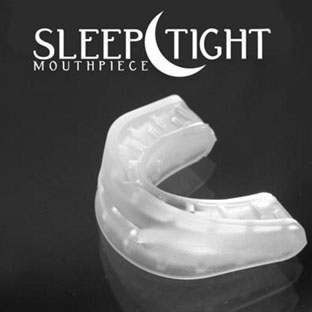
SleepTight | MAD Boil-and-bite with Air holes. | Thermoplastic | $79.95 But can be tried for 30 days for $9.95 | YES | FDA Cleared | 6-24 months | NO |
| #4 |

SnoreMeds | Boil-and-bite, 2 sizes (one for men one for woman). Breathing holes | Plastic, Latex Free, BPA Free | $49.95 | NO | FDA Cleared | 3-4 months, though manufactured for 12 months | NO |
| #5 |

Zyppah | Hybrid: TSD and MAD. Boil-and-bite with Breathing holes. | Thermoplastic latex, BPA Free | $89.95 | NO | FDA Cleared | 6-18 months, depending on usage, and individual | NO |
| #6 |

TheraSnore | Adjustable MAD Boil-and-bite, and Adjustable through small incrementations, one size fits all. | Hard acrylic, soft thermal plastics | $70.00 (£49.95) | YES | FDA, NHS (UK’s National Health Service) | 18-24 months | YES But must be fitted by your dentist. |
| #7 |

VitalSleep | Adjustable MAD. Small and regular sizes, both are micro adjustable for better fit, after boil-and-bite process. | Thermoplastic, BPA Free | $59.95 | NO | FDA Cleared | 12 months | Can be worn with partial dentures, though consult your dentist. |
| #8 |

SleepPro Contour | Adjustable MAD Boil-and-bite. | Thermoplastic BPA and Latex Free | $129.99 | NO | NHS | 6-24 months | NO |
| #9 |

SleepPro Tight | MAD Tighter fit than “EasyFit” and bigger breathing hole, allowing more room for tongue. | Thermoplastic BPA and Latex Free | $79.99 | NO | NHS | 6-24 months | NO |
| #10 |

SnoreRX | MAD Boil-and-bite. | Copolymer BPA and Latex Free | $99.00 | NO | FDA Certified | 12-15 months | NO |
| #11 |

ZQuiet | MAD Price includes two mouth pieces. Allows mouth breathing. | Thermoplastic Latex and BPA Free | $89.90 | NO | FDA Cleared | 12 months | NO |
| #12 |

SleepPro Custom | Custom fitted MAD The mouthpiece is made in a laboratory using an impression mould of your teeth. | Thermoplastic BPA and Latex Free | $259.99 | YES | NHS | 6-24 months | Should be, though consult your dentist. |
| #13 |

PureSleep | MAD Boil-and-bite and adjustable. | Thermoplastic Latex and BPA Free | $59.95 | NO | NO | 6-9 months | NO |
| #14 |

AveoTSD | TSD Comes in three sizes. Requires a prescription. By prescription only! | Silicone | $139.99 | YES | NO | 12 months | YES |
| #15 |

SleepPro EasiFit | MAD Boil-and-bite, 2 sizes, holes for breathing. | Thermoplastic BPA and Latex Free | $44.95 | YES Yes, though conclusion was don’t use it if you have mild to moderate OSAHS. | NHS | 6+ months | NO |
| #16 |

SomnoGuard AP | Adjustable MAD Recommended to let dentist do the fitting. 2 piece MAD so you can mold them separately. Boil-and-bite though a bit more complicated (cutting off edges for instance). Adjustable after with screw driver. | Thermodynamic material | $149.69 | YES | FDA, Therapeutic Goods Administration (Australia) | 12-18 months | NO But ask your dentist. |
| #17 |

SnoreDoc | MAD Boil-and-bite. Front air hole. | Thermoplastic | $39.99 | YES | FDA | N/A | NO |
| #18 |

Snorban | MAD Boil-and-bite, breathe through nose. | Thermoplastic BPA and Latex Free | $49.95 | YES | FDA | 12 months | NO |
Take A Look At Our Top 5 Recommended Snoring Mouthpieces For First Time Users.
Frequently asked questions (FAQ)
How long can the mouthpiece last?
The average lifespan of the mouthpiece will vary depending on the manufacturer but usually it is a one year window. With careful handling and normal wear and tear the appliance can last much longer, but should be replaced as soon as diminished function is noticed such as: worn spots, spotting, or tears.
Can I use them with dentures?
TSDs yes, MADs usually not, though it will depend on the model. See our mouthpiece comparison table to find the ones that you can use with your dentures.
Do TSDs and MADs stop teeth grinding?
Yes.
Are there any dangers of chocking on the devices?
No.
Can children wear TSDs and MADs?
No. Talk to your doctor if you think your child could have Obstructive Sleep Apnea (OSA).
Can the boil-and-bite process be repeated?
For most models of MADs, you can usually re-mold the device anywhere between 2 to 4 times. Some models don’t allow for it.
Can a mouthpiece or mouth guard replace a CPAP machine?
Many users and patients have had luck in using a mouthpiece in place of a CPAP machine in cases of light to mild sleep apnea. Individual evaluation should be considered when a long-term substitution is needed. For temporary use, such as a vacation or loss of the CPAP machine, an oral appliance definitely can be a good substitution.
Can people with sensitive gums wear a mouthpiece?
Careful consideration should be given by a medical professional to evaluate if any risks or complications would develop from using a mouthpiece, as this is a case-by-case basis. Generally no, but its best to have your doctor give the green light on this. Sanitation will be key with cases of gingivitis or inflamed gums to not aggravate the situation.
What if I am not happy or it doesn’t work for me?
This is the reason you should chose the product that offers a full money back guaranty like Good Morning Snore Solution or AirSnore.
But still, it’s recommends trying the device for at least a week or two to experience the full range of benefits before making that call.
How can I clean the mouthpiece without damaging it?
There are many commercial denture and orthodontic appliance cleaning solutions on the market. From Big-Box stores to supermarkets, they will be in the oral health care section. There are Dentist Certified Cleaning solutions in tablet or liquid forms, which usually require a 10 minute soak in a prepared solution. Thoroughly rinse with cold water by immersing fully then doing a 30 second swish in the formula. Air drying is important.
If stubborn residue is not being removed by swishing, a light scrub with toothpaste and water can help remove debris. Then clean as normal.
We look at this in more details for individual products in our mouthpiece reviews.
Are there any chemical free home remedies for cleaning my mouthpiece?
If the price is prohibitive, or the fear of chemicals makes a more natural solution attractive, there are several environmentally friendly stain and food particle removers that can be prepared at home with simple ingredients.
Bleach – Dentists may recommend a bleach and water soak to kill and bacteria on the mouthpiece. Soak the appliance overnight in a denture cup filled with water and one teaspoon of bleach.
Peroxide – Soaking in peroxide will help lift stains and sterilize the oral appliance, while providing an inexpensive cleaning agent. Pour a full strength cap in the middle of the mouthpiece, let it soak for one minute, then rinse well in cold water and then air dry.
Baking Soda and vinegar – This mixture will foam like the store bought tablets. Place a teaspoon of baking soda in the bottom of a denture cup, then add enough white vinegar to cover the appliance completely. This requires an overnight soak, then rinse and pat dry.
Is there clinical support for a mouthpiece as an anti-snoring device?
Mandibular advancement device (MAD) represents a therapeutic option for simple snoring to obstructive sleep apnea syndrome (OSAS). The different available studies report an improvement either on nocturnal respiratory events or on the quality of sleep. The decrease in the intensity of snoring is confirmed by the patient’s partner and by objective studies.
“Principles of mandibular advancement device applied to the therapeutic of snoring and sleep apnea syndrome,” Petitjean, Chammas, Langevin, Philit, and Robert, Laboratoire des Troubles Respiratoires liés au Sommeil, Hôpital de la Croix-Rousse, Lyon, France, Sleep, June, 2000.
“The mandibular advancement device appears to be an effective long-term solution for a significant number of patients with problem snoring and also those with mild to moderate obstructive sleep apnea.”
“Ten-year follow-up of mandibular advancement devices for the management of snoring and sleep apnea,” Jauhar, Lyons , Banham, Cameron, and Orchardson; Department of Restorative Dentistry, Glasgow Dental Hospital, Glasgow, UK, Prosthetic Dentistry, April, 2008.
“Oral appliances for the treatment of snoring and obstructive sleep apnea,” S.R. Schoem, Connecticut Children’s Medical Center Dept. of Otolaryngology, Hartford, CT, Otolaryngology – Head and Neck Surgery, February, 2000.
Oral appliances have become established treatment devices for snoring and sleep apnea. Substantial scientific evidence has demonstrated that mandibular repositioning appliances (MRA) are effective. Patients prefer oral appliances above most other treatment options. In recent years a steady stream of reports on MRA has been published. This article gives an overview of the state-of-the-art.
“State-of-the-art in the treatment of snoring and sleep apnea” (translated from Dutch), H.J. Remmelink, Ned Tijdschr Tandheelkd, January, 2003.
Join The Snore Nation Community!
To Sleep Smarter, Stop Snoring And Change Your Life!
As a subscriber, you never
miss a post AND you get access to our exclusive FREE guides & weekly content.
Sign up today to join over 5,200+ happy subscribers!